


Mind Candy is a newsletter on practical philosophy—ideas meant to be lived. Each month, we explore a new theme and examine what it demands of our lives.
This month we’re exploring emotional agility.
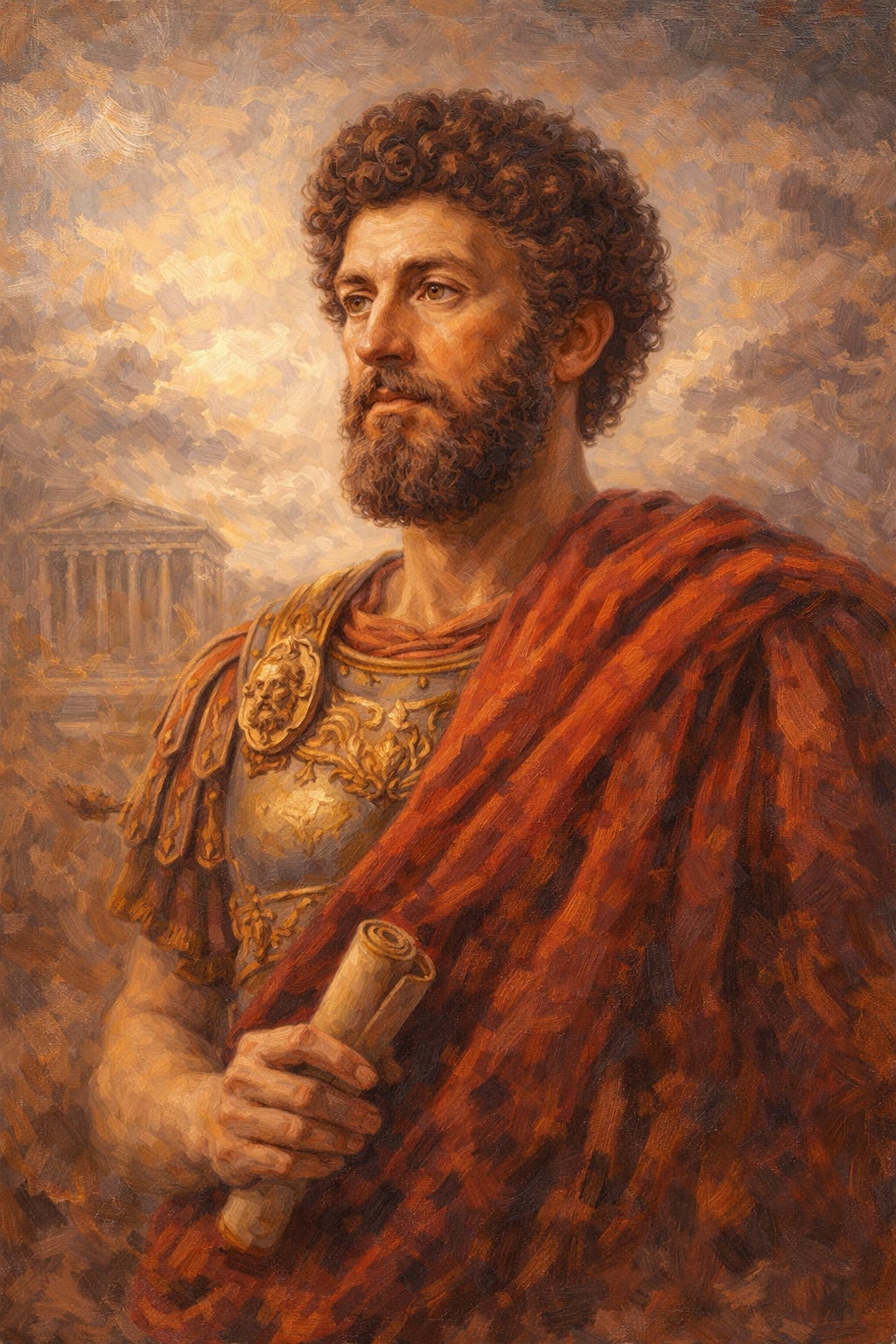
Welcome to Sweet Bites, Mind Candy’s bite-sized newsletter with thought-provoking finds to send you into the weekend with.
🍰 Mini Bites of the Week
🍰 Story:
The Roman Emperor Hadrian had a succession crisis in 138 CE. His original heir, Lucius Aelius Caesar, died unexpectedly and Hadrian was in need of a new successor.
He settled on a senator in his 50s, Antoninus Pius, but did so under a condition: Antoninus must in turn adopt two boys, Marcus Aurelius and Lucius Verus.
By indirectly adopting the two boys, Hadrian would secure Rome’s future.
At an early age, Hadrian had taken a liking to Marcus and nicknamed him Verissimus, meaning “most true,” a play on words of sorts as Marcus was born to the name of Marcus Annius Verus.
As a young man, Marcus loved the way of the philosopher. In his teens, he went so far as to dress the part and sleep on the floor, emulating those of the Cynic school of thought, rejecting the comforts of life, what the Cynics viewed as distractions from what it truly meant to live a virtuous existence.
This wasn’t a gimmick or what we may think of as youthful rebellion, it was Marcus learning, and loving, to put philosophy into practice, incorporating it into his daily life; breathing philosophy rather than just theorize about it.
As Marcus grew up watching Hadrian and Antoninus, the contrasts could not have been more different.
Hadrian’s final years were marked with tyranny and rage. The Historia Augusta records him going so far as stabbing a slave in the eye during a bout of anger only to later feel regret. In an offer of reconciliation, Hadrian tells the slave he can anything he wants, only to hear the reply, “My eye.”
Antoninus, on the other hand, was more restrained, reflecting the attitude and character Marcus had spent his life pursuing through his study of philosophy.
Rationality.
Lack of desire for praise.
Devotion to duty without complaint.
Upon Hadrian’s passing, Marcus observed Antoninus in power for twenty-three years, watching how he handled the role of Emperor. These lived qualities of Antoninus would be Marcus’s own guiding light when it was time for him to take the throne.
Marcus’s own Meditations reflect such as he praised Antoninus’s teachings but is silent on Hadrian.
His Meditations, more than anything, however, can be thought of as spiritual exercises according to the philosopher Pierre Hadot—reflections to help one transform their life, working to shape their automatic responses to events.
The Stoics thought emotions arose in three stages:
First movement: the automatic impression that strikes us.
Assent: the judgment we’ve assigned to the impression.
Emotion: the emotional response that flows from our judgment.
It was believed that judgments could be controlled by our reasoning faculties. We may not be able to control the first movement impressions we receive as they are automatic, but we can change what emotions we experience by adjusting our judgments of the impression.
Marcus’s frequent writings on dealings with people and the reminder we are here to work with one another are reminiscent of not just the concept of cosmopolitanism, but also an individual looking to calm his frustrations with those he interacts with.
Marcus, for example, reminds himself in the Meditations, “You don’t have to turn this into something. It doesn’t have to upset you. Things can’t shape our decisions by themselves.”
The reason Marcus was known as a great emperor—the last of the five great emperors—is displayed directly in his Meditations. They represent a man, the most powerful man in the world at the time, fighting to live up to his own expectations of what good character is.
To remain truthful to himself.
To embody Verissimus.
🍰 4 Quotes
Marcus Aurelius on coming back to oneself
“When jarred, unavoidably, by circumstances, revert at once to yourself, and don’t lose the rhythm more than you can help. You’ll have a better grasp of the harmony if you keep on going back to it.”
—
Cicero on sorrow
“… if you let your sorrow overwhelm you, you’re not showing how much you loved your friend, only how much you love yourself.”
—
Epictetus on provocation
“If someone succeeds in provoking you, realize that your mind is complicit in the provocation.”
—
Seneca on impulse
“An emotion, then, does not consist in being moved by the appearances of things, but in surrendering to them and following up this casual impulse.”
🍰 3 Reflections from me:
I. We weaken an emotion’s authority over us when we can first and foremost witness it.
II. The emotions we experience—anger, joy, frustration—are interpretations of the world we’re experiencing. It is up to us to decide what we do with those judgments.
III. We don’t outgrow an emotion’s authority, we learn to witness it and understand we don’t have to grant it control over us.

🧠 This Week in Mind Candy 📚
🧘🏻 Monday Meditation:

🦉 Wednesday Wisdom:


👀 This Week’s Recommendations
📰 Article Worthy of a Read: Stoicism and Emotion by Jack Maden
🔑 Key Takeaway: “The idea is that we use our judgment to accept these natural feelings and impulses, and then gently point out to ourselves that we don’t have to let them warp our view of the world, rule our thoughts, or govern our actions (indeed, the only governors of our actions should be the four cardinal Stoic virtues: wisdom, courage, justice, and temperance).”
📖 Book on Weekly Theme: A Human History of Emotions by Richard Firth-Godbehere
🔖 Summary: Drawing on psychology, neuroscience, philosophy, art, and religious history, Richard Firth-Godbehere takes readers on a fascinating and wide ranging tour of the central and often under-appreciated role emotions have played in human societies around the world and throughout history—from Ancient Greece to Gambia, Japan, the Ottoman Empire, the United States, and beyond.
🔑 Key Takeaway: “Throughout history, certain powerful emotions have acted as a driving force for change. On many occasions, desire, disgust, love, fear, and sometimes anger seem to take over cultures, making people do things that can change everything.”
🎧 Podcast Recommendation: How Stoics Tamed Their Strongest Emotions by Allan John (What Is Stoicism?)
🎥 Video to Watch: The Daily Stoic put together a short video on how a Stoic handles/approaches emotions.

Think someone you know would enjoy these? Hit below to forward and spread the love.
Until next time,

D.A. DiGerolamo
We are a participant in the Amazon Services LLC Associates Program, an affiliate advertising program designed to provide a means for sites to earn advertising fees by advertising and linking to Amazon.com.
Thanks for the recommendation!